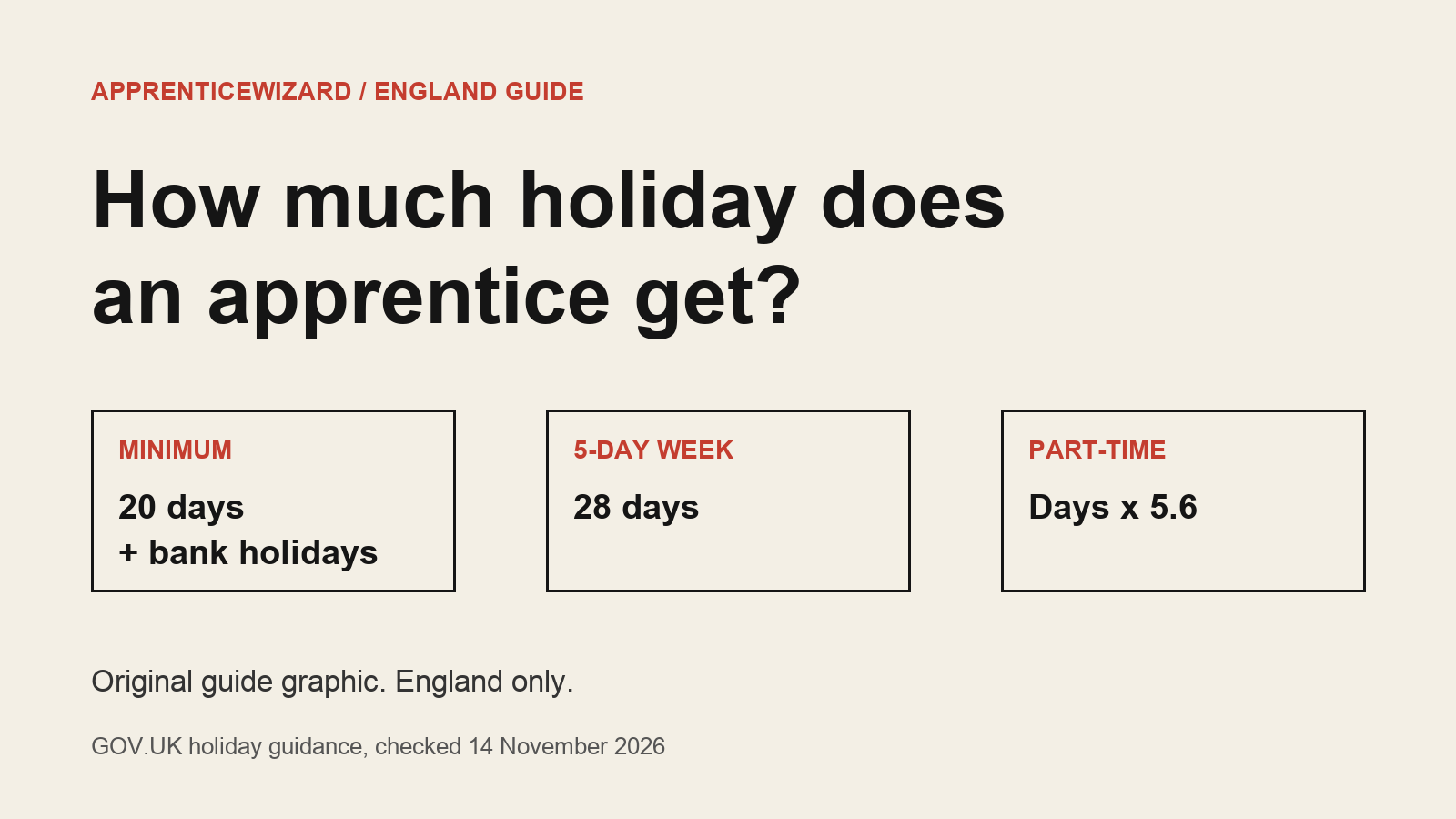
Apprentices in England get at least 20 days' paid holiday a year, plus bank holidays. That is the minimum GOV.UK sets out in its guide to becoming an apprentice for a full working week. Your employer can offer more than the legal minimum, but not less.
If you work a 5-day week, the legal minimum works out at 28 days' paid leave a year. Fewer working days means fewer days of leave, worked out with one simple sum. This guide shows the sum, what your contract should tell you, and the exact lines to use when you ask about holiday or book it.
It covers England. Northern Ireland has its own guidance on nidirect, and there is a short note on it below.
What the minimum is
GOV.UK's Become an apprentice guide says: "You'll get at least 20 days paid holiday per year, plus bank holidays." Holiday pay is one of the employee rights you have as an apprentice, alongside the minimum wage and paid time for training.
The wider holiday entitlement guidance says almost all workers are entitled to 5.6 weeks' paid holiday a year. Most workers on a 5-day week must get at least 28 days. That is the equivalent of 5.6 weeks.
Two details catch people out:
- Bank holidays can be part of the 28. GOV.UK says bank holidays do not have to be given as paid leave, and an employer can choose to count them inside your statutory leave.
- The legal minimum stops at 28 days. Someone working 6 days a week is still entitled to 28 days' paid holiday by law. Anything above that comes from the employer.
How to work out your days
The sum is your working days per week multiplied by 5.6.
| Days you work each week | Minimum paid holiday a year |
|---|
| 5 | 28 days (5 × 5.6) |
| 4 | 22.4 days (4 × 5.6) |
| 3 | 16.8 days (3 × 5.6) |
GOV.UK uses the 3-day example itself: a worker on 3 days a week must get at least 16.8 days a year. If your hours change from week to week, your leave builds up based on the hours you have worked instead. GOV.UK's holiday entitlement calculator handles both cases.
If you are looking at a part-time role, our guide to part-time apprenticeships in England covers how the hours and training fit together.
Read the holiday line in the advert
Many adverts list holiday under benefits. Read it closely, because the same number can mean different things.
A real example: on 14 November 2026, Yunex Traffic's Degree Apprentice - Data Analytics Engineer listing on Find an apprenticeship said "26 days holiday, increasing up to 29 days with length of service". That listing does not say whether bank holidays are on top. Yunex's own job page does: it says "26 days holiday plus bank holidays". Reading both, or asking, gives you the full picture.
Look for three things:
- The number of days. Check it is at least 20 plus bank holidays for a full-time role.
- Whether bank holidays are included. "25 days plus bank holidays" is more leave than "25 days including bank holidays".
- Any extra leave for service. GOV.UK says employers can add rules to extra leave above the minimum, such as needing to be employed for a certain time first.
Ask before you sign
If the advert or offer does not make it clear, ask. Holiday is a normal question once you have an offer, and asking in writing gives you a record.
Example (after an offer):
"Thank you for the offer. Could you confirm how many days of paid holiday I get each year, and whether that includes bank holidays?"
Example (at the end of an interview):
"How does holiday work in this team? Are there times of year when leave is restricted?"
For more questions worth asking, see our list of questions to ask at an apprenticeship interview.
How to book holiday
GOV.UK's booking time off guidance sets a general notice rule: give notice at least twice as long as the leave you want, plus 1 day. For 1 day off, that is 3 days' notice.
Your employer can refuse a request, but must give notice of at least the length of the leave you asked for, plus 1 day. Employers can also tell staff when to take leave, such as bank holidays or Christmas, and restrict leave at busy times. They cannot stop you taking your leave altogether.
If your contract sets different notice rules, the contract applies. Check it before you book.
Example (booking email):
"Hi Sam, could I book annual leave from Monday 12 April to Wednesday 14 April? That's 3 days. I've checked it doesn't clash with my training days."
Swap in your manager's name and your own dates. Keep the reply.
Northern Ireland
nidirect sets the same statutory minimum of 5.6 weeks, or 28 days for someone working five days a week. It notes there are 10 bank and public holidays in Northern Ireland, and that paid leave on them can count towards the minimum.
If something looks wrong
Check your contract and payslips first. If your leave or holiday pay still looks short, GOV.UK points apprentices to Acas for free and confidential advice on rights at work. Our guide on how to check your apprentice pay covers the pay side.
Find apprenticeships
You can search apprenticeships for free on the ApprenticeWizard Finder. Open each advert and check the holiday line before you apply.
Sources: GOV.UK, Become an apprentice: what you'll get; GOV.UK, Holiday entitlement (entitlement and booking time off); nidirect, Holiday entitlements. Checked 14 November 2026.