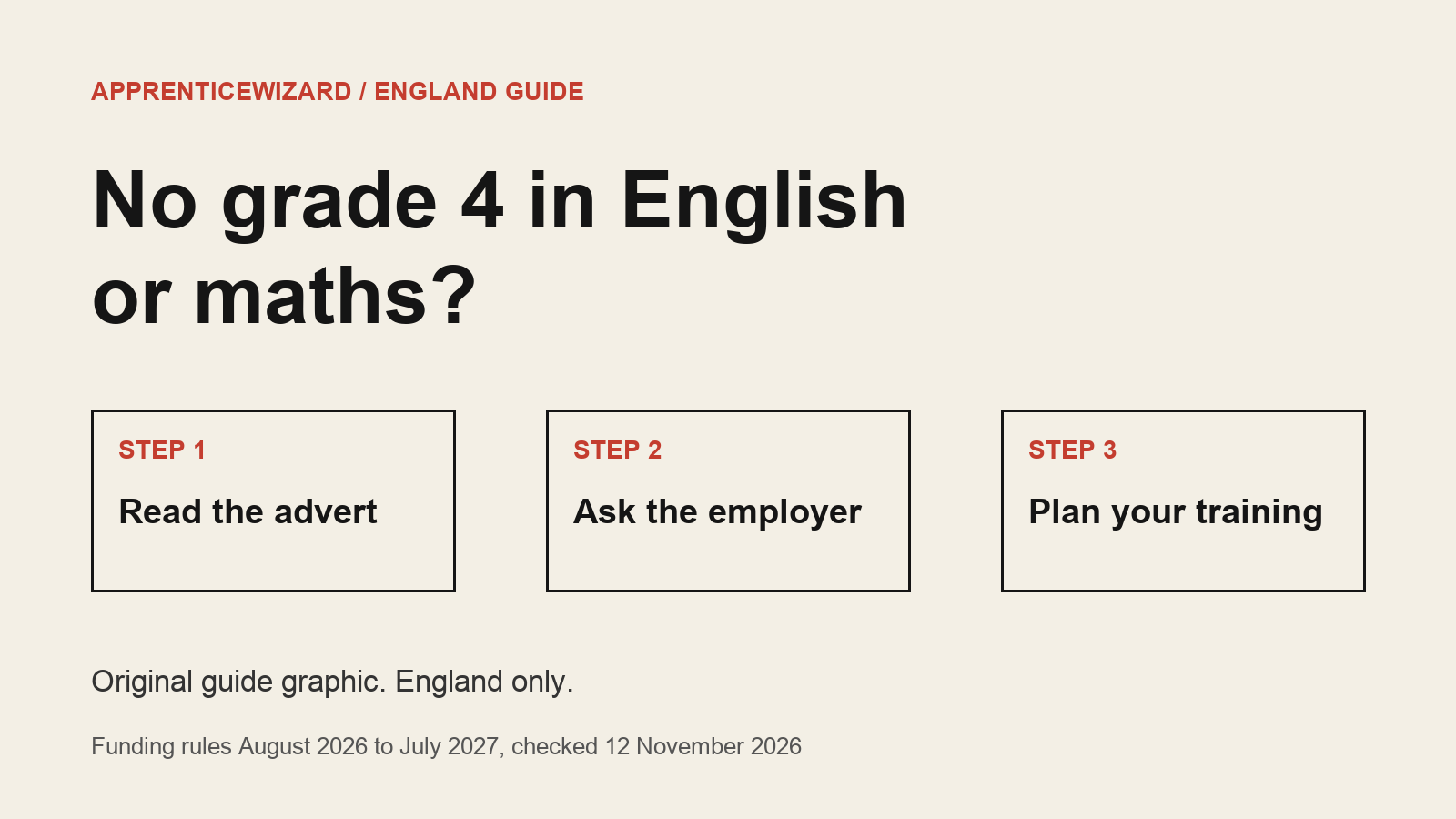
No grade 4 in GCSE English or maths does not automatically rule you out of an apprenticeship in England. The government's funding rules for apprenticeships starting from August 2026 cover GCSE or Functional Skills study in English and maths, up to level 2, for apprentices who do not already hold a grade 4 (or C) in those subjects.
Whether you can apply for a particular role depends on what its advert asks for. The funding rules cover the study itself, not each advert's entry grades. So the useful question is not "Do I need GCSEs?" but "What does this advert ask for, and what will this employer accept instead?"
This guide covers England only. Scotland, Wales and Northern Ireland run their own apprenticeship systems.
What the funding rules say
The Department for Education's apprenticeship funding rules for August 2026 to July 2027 (version 3) set out how English and maths work inside an apprenticeship. The answer depends on your age when your training starts.
If you start aged 16 to 18 and do not already hold a suitable level 2 qualification, English and maths are a mandatory part of your programme. The rules say the apprentice will be funded "to achieve up to an approved level 2 qualification". On a level 3 or higher apprenticeship, you must hold or achieve level 2 in both subjects before you can complete it.
If you start aged 19 or over, English and maths are optional. They are funded up to level 2 if your employer agrees that they should be part of your training plan. If you opt in, you usually do not need to pass them to reach the end of your apprenticeship. The rules note an exception where English or maths is an essential part of a mandatory qualification in the apprenticeship, so check with your training provider.
If your employer does not agree, the rules say an apprentice aged 19 or over can use their legal entitlement to study English and maths up to level 2 in their own time, funded separately through the Adult Skills Fund.
The rules name two kinds of qualification that can be funded: GCSE English language or maths, and Functional Skills English or maths up to level 2. Accepted equivalents are listed separately on GOV.UK.
Step 1: read the qualifications section of the advert
Open the full advert, not just the summary card. Find the part that lists qualifications or entry requirements, then read the exact words next to each grade.
Look for words like "essential", "desirable" and "or equivalent". Each one changes what you should do next:
- Essential or required: the employer expects you to have it before you start. Ask before you apply if you are close, waiting for a resit or hold a different qualification.
- Desirable: it helps, but it is not a hard stop. Apply and show what you can offer instead.
- Or equivalent: the employer accepts other qualifications. Ask which ones count for this role.
Some adverts list higher qualifications too, such as A levels for a degree apprenticeship. Our guide to GCSE, A level and degree apprenticeship requirements explains how to read those.
Step 2: ask the employer one clear question
If the advert is unclear, ask before you spend an evening on the application. Keep it short and specific. Name the role, say what you have, and ask one question.
Here is an example email. Swap in your own role, subject and qualification:
Hi, I'm interested in the [role] apprenticeship. I don't have GCSE maths at grade 4 yet. Would you accept Functional Skills Level 2 maths instead?
If you have not taken anything yet, change the last line:
Would I be able to work towards Functional Skills Level 2 maths during the apprenticeship?
Send it to the contact named on the advert. If there is no contact, use the employer's careers or early careers email address. Keep a note of the date you sent it, and wait a few working days before you follow up.
Step 3: if you are 19 or over, raise it at interview
Because English and maths are optional for apprentices aged 19 or over, it helps to ask about them directly. Here is an example line you could use:
Could English or maths be part of my training plan?
It shows you know how the programme works and that you want to improve. If the employer says no, you still have the Adult Skills Fund route described above.
If you have a learning difficulty or disability
The funding rules include exceptions to the usual English and maths minimum requirements. Where a learning difficulty or disability is a barrier to meeting them, providers should consider offering the flexibility to achieve Entry Level 3 Functional Skills in the adjusted subject instead. Each case is considered individually, against conditions set out in the rules, such as an education, health and care (EHC) plan or an evidence-based assessment. Ask your training provider whether this could apply to you.
A quick checklist before you apply
- Read the qualifications section of the full advert.
- Mark each grade as essential, desirable or "or equivalent".
- If it is unclear, send the example email above.
- Check your age at the start of training. It changes whether English and maths are required or optional.
- Keep a copy of the employer's reply with your application notes.
Find apprenticeships that fit
You can search apprenticeships for free on the ApprenticeWizard Finder. Open each advert and check its entry grades before you start the application.
Source: Department for Education, Apprenticeship funding rules, August 2026 to July 2027, version 3, paragraphs 47, 53, 55, 57, 58 and 59. Checked 12 November 2026.