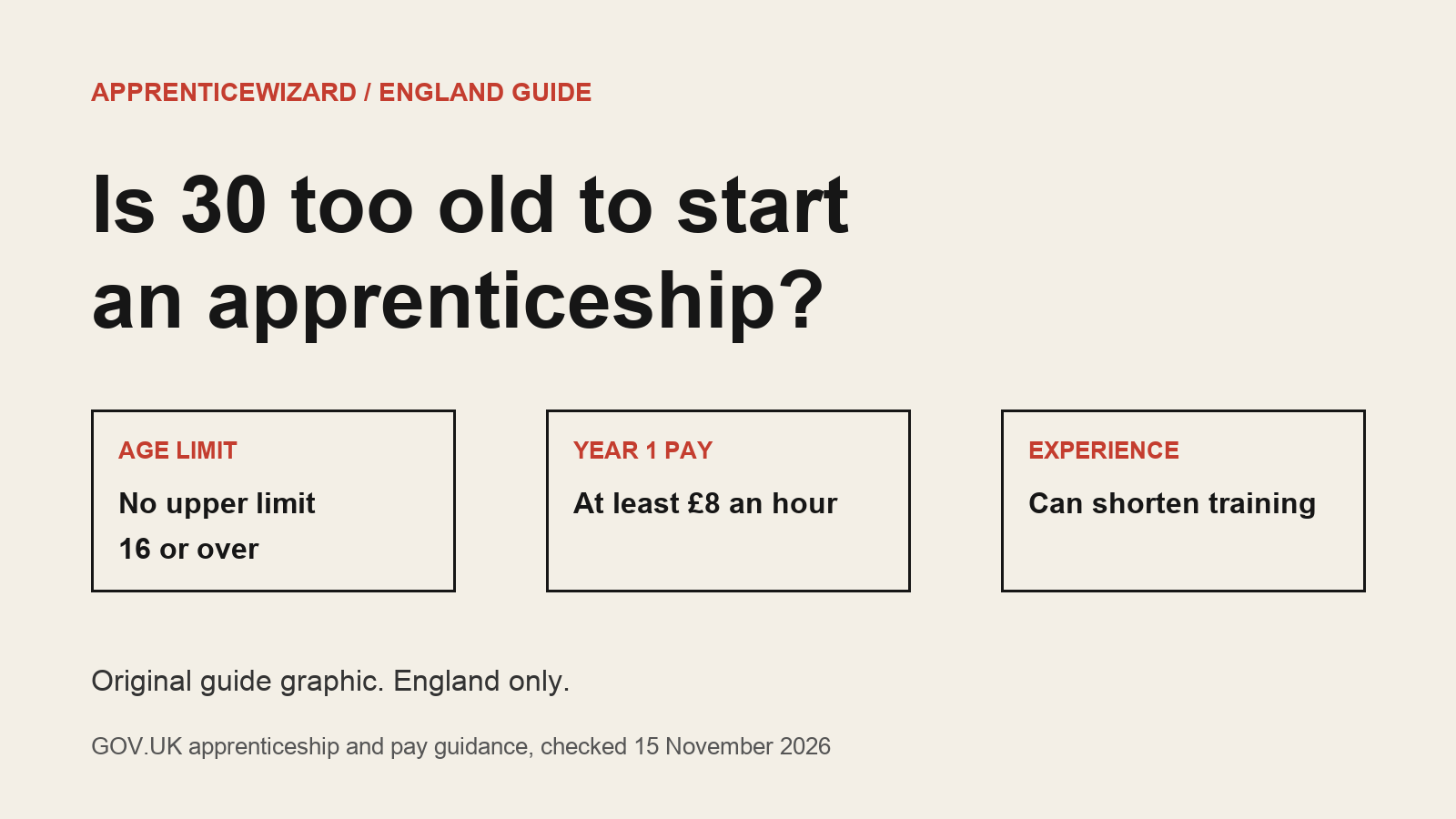
No, 30 is not too old to start an apprenticeship. GOV.UK sets no upper age limit. To start an apprenticeship in England, you need to be 16 or over, living in England and not in full-time education. There is no other age rule.
So the real questions at 30 are practical ones. What will you be paid? Will your experience count? And what do you say when an interviewer asks why you want to start now? This guide answers each one from GOV.UK's guidance, then gives you example lines to adapt.
It covers England. Scotland, Wales and Northern Ireland run their own apprenticeship schemes, and GOV.UK points you to each of them.
Who can start an apprenticeship
GOV.UK's Become an apprentice guide lists three conditions. You need to be:
- 16 or over
- living in England
- not in full-time education
There is no maximum age on that list. A 30-year-old career changer meets the same conditions as a school leaver.
Each advert sets its own entry requirements. Read those carefully, because they decide whether you can apply, not your age.
What you will be paid
This is the part to plan for. GOV.UK's pay and conditions page says apprentice pay depends on your age and the year of your apprenticeship:
- If you are 19 or over and in your first year, the minimum is the apprentice rate. From April 2026 that is £8 an hour.
- If you are 19 or over and have finished your first year, you are entitled to the National Minimum Wage or National Living Wage for your age. From April 2026, that is £12.71 an hour if you are 21 or over.
The National Minimum Wage rates page lists both figures. Those are minimums. Employers can pay more. Your employment contract should confirm your rate of pay.
If you are moving from a full-time job, compare the first-year pay in the advert with what you earn now before you apply.
You must also be paid for your training. GOV.UK says your training time is at least 20% of your normal working hours, and it counts as paid work.
Your experience can count
GOV.UK says you could spend less time training, or qualify earlier, if you have relevant experience. That includes:
- qualifications, such as an NVQ in a relevant subject
- industry or sector experience
- training you have already completed, such as an IT course
You agree this with your training provider and employer when you start. If you have spent years in a related job, say so early. It can change how long your apprenticeship takes.
Apprenticeships can take from 8 months to 6 years, depending on the type and level, so a shorter route is worth asking about.
Pick a level that fits
GOV.UK lists each apprenticeship level with its equivalent education level:
| Level | Name | Equivalent |
|---|
| 2 | Intermediate | GCSE |
| 3 | Advanced | A level |
| 4 to 7 | Higher | Foundation degree and above |
| 6 and 7 | Degree | Bachelor's or master's degree |
If you already hold qualifications, a higher level may suit you better than starting at Level 2. The advert's entry requirements tell you what each employer expects.
What to say when they ask "why now?"
An interviewer may ask why you are changing direction. A short, honest answer helps. These are examples to adapt, not scripts to copy word for word.
To lead with what your work so far proves:
"I've spent [X] years in [job], where I [one thing you did well]. Now I want to train properly in [field]."
To explain the timing:
"I know what I want to do now, and an apprenticeship lets me learn it properly while I work."
If the pay comes up:
"I know the first year can pay less than I earn now. I've planned for it, and I'm committed to finishing."
To ask about your experience:
"I've done [course or role] before. Could that count towards the training, so I finish sooner?"
Keep each answer short and specific. Swap the brackets for real details from your own work.
A quick checklist before you apply
- Confirm you meet the three GOV.UK conditions: 16 or over, living in England, not in full-time education.
- Read the advert's entry requirements and wage.
- Work out whether the first-year pay works for you.
- Note any qualifications or experience that could shorten your training.
- Prepare your "why now?" answer.
Where to look
You can search live roles on the government's Find an apprenticeship service. You can also search apprenticeships on ApprenticeWizard.
If you are not selected, GOV.UK says you can ask for feedback, and the Apprenticeship helpline can answer questions on 0800 015 0400.
Sources
- GOV.UK, Become an apprentice, checked 15 November 2026
- GOV.UK, Become an apprentice: what you'll get, checked 15 November 2026
- GOV.UK, Find an apprenticeship, checked 15 November 2026
- GOV.UK, National Minimum Wage and National Living Wage rates, checked 15 November 2026