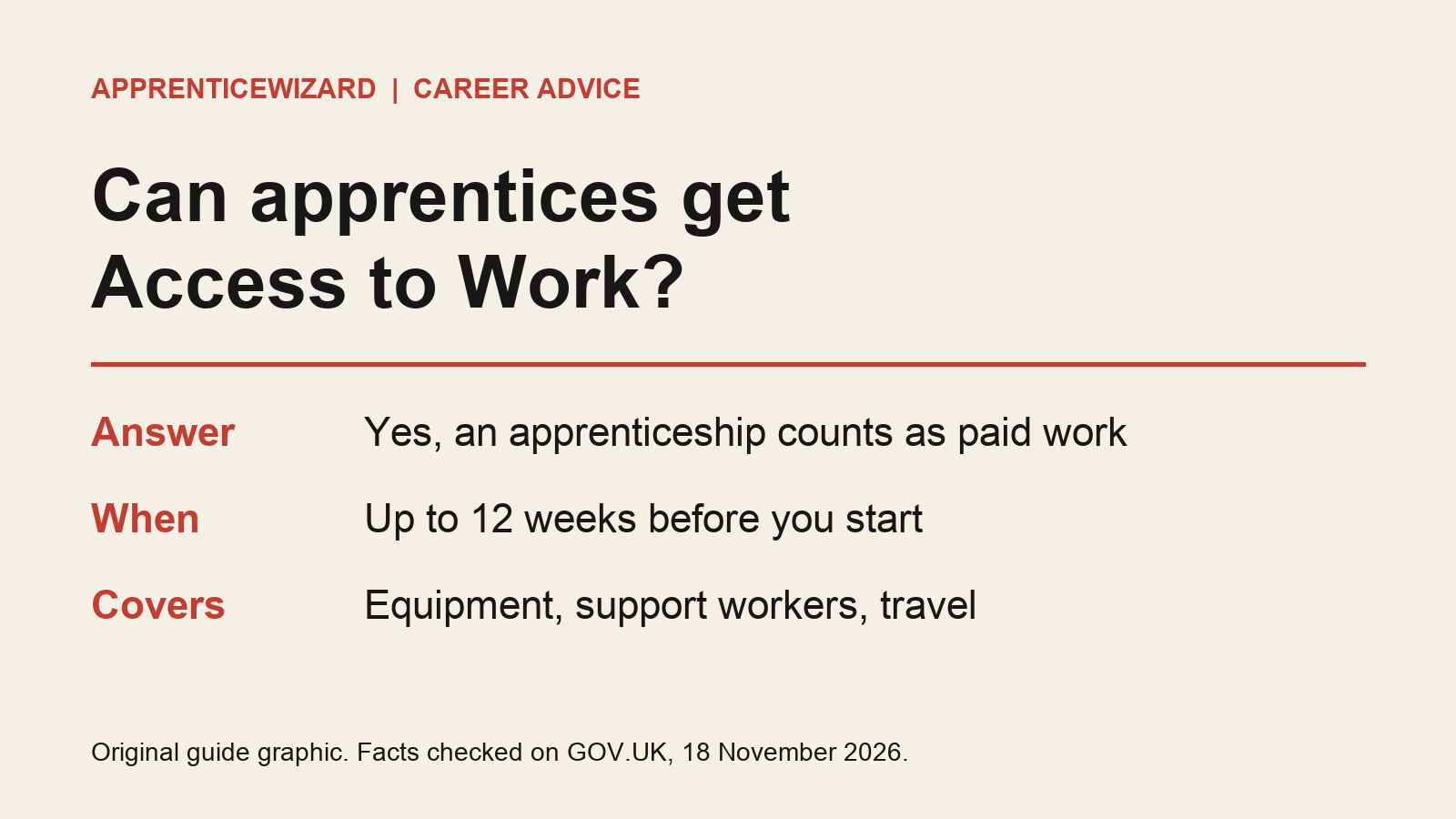
Yes. If you have a disability or health condition, you can apply for Access to Work as an apprentice. GOV.UK's Access to Work eligibility page lists an apprenticeship as a kind of paid job that counts, alongside employment, internships and work placements.
You also don't have to wait until your first day. You can apply if you're about to start paid work in the next 12 weeks, so you can apply once your start date is 12 weeks away or less. This guide covers who can apply, what the grant can pay for, and example lines to adapt for your employer and your application.
Who can apply
For a grant towards practical support, GOV.UK says you must:
- have a physical or mental health condition or disability that means you need support to do your job or get to and from work
- be 16 or over
- be in paid work, or be about to start or return to paid work in the next 12 weeks
- live and work in England, Scotland or Wales
You don't need a diagnosis to apply. GOV.UK gives examples of conditions that can count, including dyslexia, ADHD, autism, diabetes, epilepsy, anxiety and depression, a hearing impairment, and temporary conditions such as a broken leg.
If you're employed, you can get support however much you earn or have in savings. You can't get Access to Work for voluntary work. If you're not sure whether you qualify, GOV.UK suggests calling the Access to Work helpline on 0800 121 7479.
Northern Ireland has its own scheme, Access to Work (NI), run by the Department for Communities. Check nidirect for how it works and how to apply.
What it can pay for
The support depends on what you need. GOV.UK's Access to Work guide gives these examples of what a grant could help pay for:
- specialist equipment and assistive software
- support workers, such as a BSL interpreter, a job coach or a travel buddy
- the cost of travelling to work if you can't use public transport
- adaptations to your vehicle so you can get to work
- physical changes to your workplace
If you get a grant, you don't have to pay it back, and it won't affect any other benefits you get. You or your employer may need to pay some costs up front and claim them back later.
There's also separate mental health support through Access to Work. It can include a tailored plan and one-to-one sessions with a mental health professional. You apply to either Able Futures or Maximus, not both, and you can only have this support once.
Your employer still has duties
Access to Work doesn't replace your employer's duty. GOV.UK says employers must make reasonable adjustments so workers with disabilities or health conditions are not substantially disadvantaged, and that this applies to apprentices and trainees.
So it's worth talking to your employer as well as applying. A short message is enough to start. These are examples, so change them to fit you.
Example line for your employer, adapt it: "I'm dyslexic. Software that reads text aloud would help me with written tasks. Can we talk about adjustments?"
Example line before you start, adapt it: "I've accepted the apprenticeship and I'm applying for Access to Work so support is in place for my start date. Who should I give as my workplace contact?"
What to say when you apply
You can apply online or by phone. GOV.UK says you'll need to give:
- your contact details
- your workplace address and postcode
- how your condition affects your work and what support you think you need
- details of a workplace contact who can confirm you work there (they won't be contacted without your permission)
- your National Insurance number, if you have it
The part that matters most is how your condition affects your work. Be specific about the task, what makes it harder, and what would help. Mention your training too, because it's part of the job for an apprentice.
Example line for your application, adapt it: "Reading long documents takes me longer because of my dyslexia. Text-to-speech software would help me keep up at work and in my training."
Another example, adapt it: "I can't use public transport because of my condition. I need help with the cost of taxis to get to my workplace."
If you need the form in braille, large print or audio, call the helpline. Relay UK users can dial 18001 then 0800 121 7479.
Support at interviews
Access to Work can also help pay for communication support at a job interview. That includes a BSL interpreter or lipspeaker if you're deaf or hard of hearing, or communication support if you have a physical or mental health condition or a learning difficulty. The eligibility rules for interview support are different, so check the GOV.UK page before you apply.
Quick checklist
- Accept your offer and note your start date. You can apply from 12 weeks before it.
- Apply for Access to Work up to 12 weeks before you start.
- Write down how your condition affects specific tasks at work and in training.
- Tell your employer what would help and ask who your workplace contact will be.
- Keep receipts if you or your employer pay anything up front.
We checked the GOV.UK and nidirect pages on 18 November 2026. Rules can change, so read the live pages before you apply.