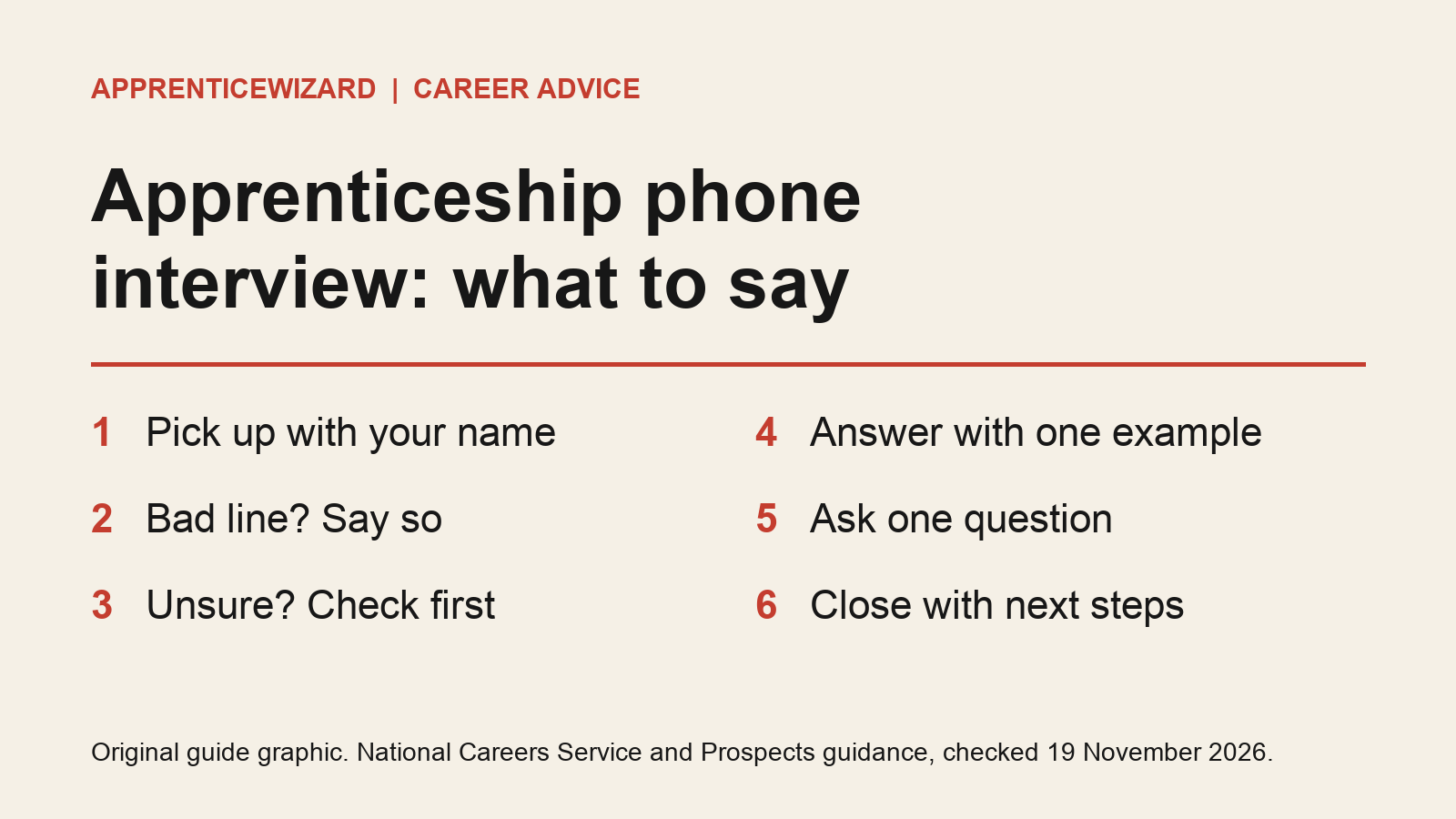
In an apprenticeship phone interview, plan your first and last lines before the call. Answer with a greeting and your name, say so if the line is bad, check any question you're not sure about, answer with one real example, ask one question about the role and finish by asking when you'll hear back.
Phone interviews often come first. The National Careers Service says a phone interview "usually takes place in the early stages of applying for a job", and that the employer will want to see how enthusiastic you are about joining. Prospects says a telephone interview typically lasts between 20 and 45 minutes, and an initial screening interview can last between 15 and 30 minutes.
On the phone, the interviewer only has your voice to go on. They can't see you nod or smile, so what you say, and how clearly you say it, carries the whole call.
This guide gives you six example lines to adapt. They are examples, not scripts. Change the words so they sound like you, and only talk about things you have really done.
If your interview is on camera instead, read our video interview guide: what to say.
Before the call
The National Careers Service says to prepare as you would for a face-to-face interview. A short version:
- Check the employer has the right phone number for you, and note the date, time, caller's name, company and role.
- Read the job description and go over your application again.
- Make a few prompt cards. Prospects suggests short bullet points rather than lots of paper.
- Find somewhere quiet, charge your phone and be ready 10 minutes early.
The National Careers Service also says standing up can make some people feel more confident, and that smiling while you talk makes you sound friendly.
1. Pick up with your name
Prospects suggests a set greeting, so you sound ready from the first second.
Example line, adapt it: "Good morning, [your name] speaking."
Around the time of your interview, answer unknown numbers this way too, so you're not caught saying "Hello?" when the recruiter rings.
2. Bad line? Say so
The National Careers Service says to tell the interviewer if the line is bad or you cannot hear. Don't guess at a question you only half heard.
Example line, adapt it: "Sorry, the line's breaking up. Could you say that again?"
3. Unsure? Check first
The National Careers Service says it's fine to ask the interviewer to repeat a question if you're not sure what they're asking. It also suggests leaving a small gap at the end of each question before you answer.
Example line, adapt it: "Just to check, are you asking about [what you think they mean]?"
This buys you a few seconds to think, and it stops you answering the wrong question.
4. Answer with one example
The National Careers Service suggests using the STAR method to plan your answers: situation, task, action and result. On the phone, keep it tight. One sentence for the situation, then what you did and what happened.
Example line, adapt it: "At [school, club or job], I [what you did]. Because of that, [result]."
School projects, part-time work, sport, volunteering and caring for family all count. Never make up experience to fill a gap. Our STAR method guide has more worked examples.
5. Ask one question
Prospects warns against ending with a polite thanks and hanging up, so prepare a couple of questions. One of the National Careers Service's examples is asking what an average day would be like.
Example line, adapt it: "What would an average day look like for an apprentice in your team?"
Prospects suggests you stay away from questions about salary, holiday or start dates at this stage. For more ideas, see our list of questions to ask at the end of an apprenticeship interview.
6. Close with next steps
The National Careers Service says to thank the employer for their time, and that it's okay to ask when to expect the outcome.
Example line, adapt it: "Thanks for your time. When can I expect to hear about the next stage?"
After the call
Write down the questions you were asked while you still remember them. The National Careers Service suggests picking two or three things that went well and what you could do better, then updating your prompt cards. Prospects says that if you don't hear back within a couple of weeks, you can call or email to follow up.
Quick checklist
- Greeting and your name when you pick up
- Ask them to repeat if the line is bad
- Check any question you're not sure about
- One real example: what you did, then what happened
- One question about the role
- Thank them and ask about next steps
Looking for roles to apply for? Search live listings on ApprenticeWizard's free Finder.