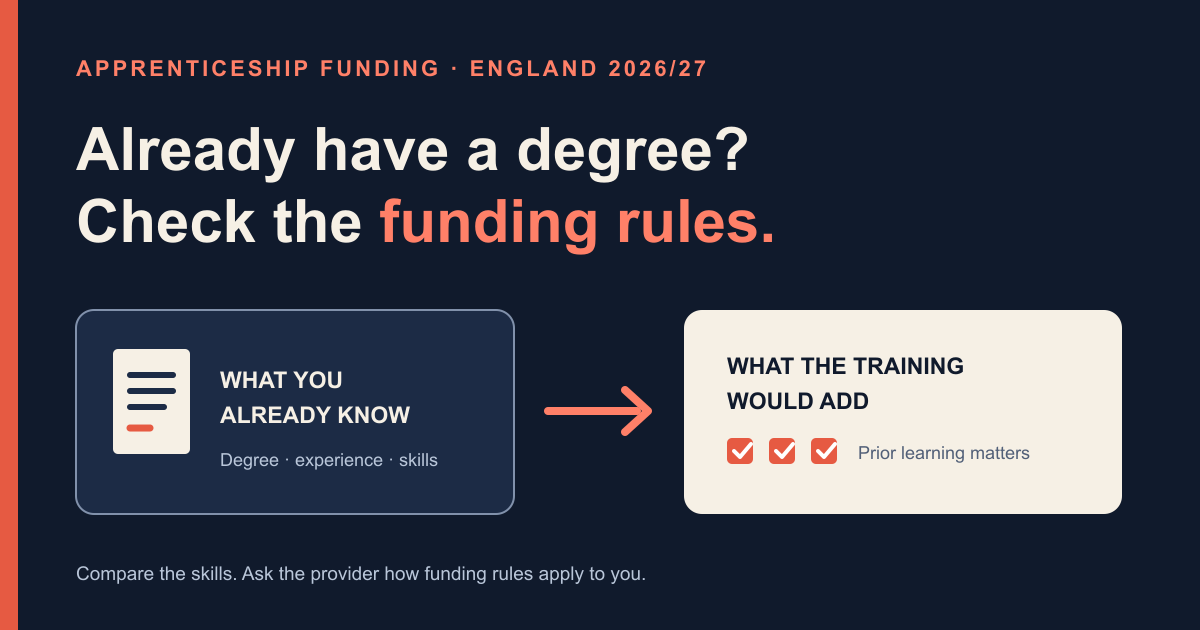
Yes. You can start an apprenticeship after earning a degree, but whether the training can receive government funding depends on what you have already learned and what the apprenticeship would add. England's 2026–27 rules allow funding at a level above a qualification you already hold. At the same or a lower level, the apprenticeship must meet an additional test.
When a degree does not rule out funding
The government's Find an apprenticeship service says you can have a previous qualification, including a degree, and still start an apprenticeship. Funding is a separate question. The 2026–27 apprenticeship funding rules apply to apprenticeships in England starting from 1 August 2026 to 31 July 2027.
Paragraph 68.1 says an apprentice may be funded for an apprenticeship at a level above a qualification they already hold. So a degree does not automatically rule out a higher-level apprenticeship. The rule is about the level of the apprenticeship and your existing qualification; it does not promise an offer, a place or funding for a particular vacancy.
If the apprenticeship is at the same or a lower level than a qualification you already hold, paragraph 68.2 sets out two conditions. It must develop significant new skills, and the provider must be able to show that the training content is materially different from your previous qualification or apprenticeship.
For example, someone with a History degree could ask: “What significant new skills would a Level 4 accounting apprenticeship teach me?” That is a question to adapt, not a real applicant's case or a claim that any particular provider will approve the funding. The key is to compare the actual skills and training, not only the qualification titles.
What the provider should check
The provider's initial assessment includes your prior learning and experience. The rules tell providers to review what you already know, check whether the apprenticeship is suitable and tailor the training plan. For learners aged 19 or over, the provider must check the personal learning record if one exists and carry out a skills scan. It should share the assessment outcome with you and your employer so you can understand the plan and how earlier learning has been accounted for.
Bring the provider evidence that helps make this comparison. A transcript, module list, certificates or examples of relevant work can help you describe your existing skills. Then ask which parts of the apprenticeship are new, where the training differs from what you have studied and how that difference will appear in your plan. The version 3 funding rules PDF sets out these requirements in paragraphs 27, 35, 38, 63, 65 and 68.
A short check before you apply
Make two columns: “What this apprenticeship teaches” and “What I already studied or can do”. Use the apprenticeship standard and your course materials to fill them in. Mark the skills that are genuinely new, then take the comparison to the training provider.
Ask the provider to explain how it will assess your previous learning, whether the apprenticeship is at a higher, same or lower level than your qualification, and how any relevant prior learning changes the training plan. If the roles interest you, our guide to starting an apprenticeship search has a simple first step. Our article on degree progression during an apprenticeship covers a different question: what qualification you might earn while training.
These funding rules apply in England. Wales, Scotland and Northern Ireland have separate apprenticeship systems, so check the rules where the job is based. The provider must assess your circumstances; do not assume an earlier degree makes you eligible or ineligible without that conversation.
When we checked our database on 8 November 2026, it contained 6,432 active apprenticeship and internship records linked to 2,986 distinct employers as grouped in our database. Of those, 3,720 had a listed application deadline from 8 November 2026 through 3 January 2027. Those are database records, not a promise that every employer's advert is still open. Check the employer's live advert before applying.
ApprenticeWizard brings apprenticeship and internship opportunities together in one searchable database, with a free application tracker. Vacancy figures above were taken from our database on 8 November 2026. Check the employer's advert before applying. Start your search.